

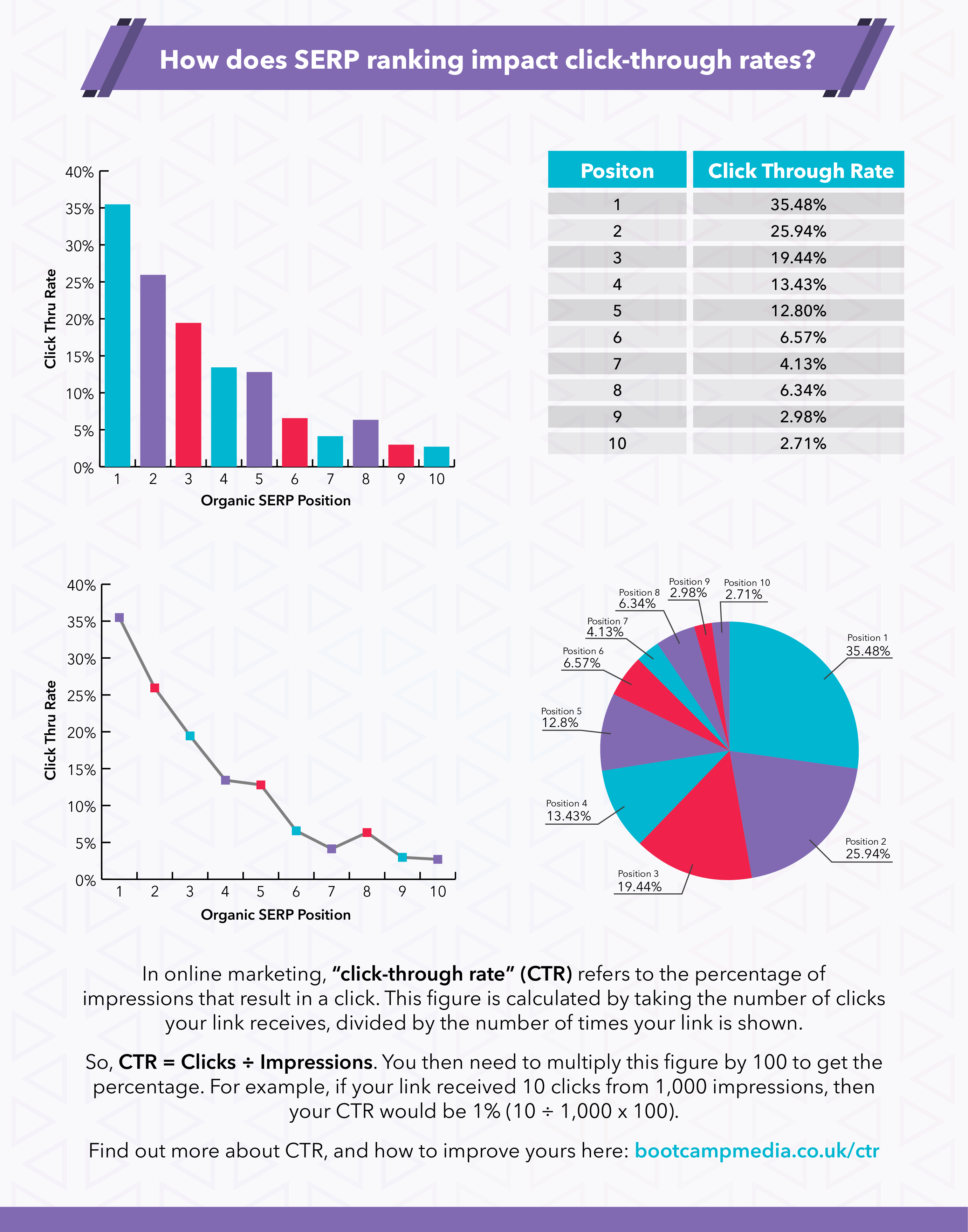
In online marketing, “click-through rate” (CTR) refers to the percentage of impressions that result in a click. In addition to measuring CTR for Search and online advertising, digital marketers will often need to monitor their email click through rate and newsletter click through rate too.
CTR is calculated by taking the number of clicks your ad or link receives, divided by the number of times your ad or link is shown.
Here is the easiest CTR calculator formula to use if you want to work out your own click-through rates manually.
CTR = Clicks ÷ Impressions. You then need to multiply this figure by 100 to get the percentage. For example, if your link received 10 clicks from 1,000 impressions, then your CTR would be 1% (10 ÷ 1,000 x 100).
A search engine optimization campaign has the ultimate goal of ranking at the top of the search engine results pages (SERPs). But an organic listing with a Top 10 ranking in Google isn’t much good if nobody clicks on it. You will need to work on improving your organic click-through rate to gain valuable leads from Google and other search sources.
CTR can also help marketers to build a picture, particularly when calculating metrics to do with ROI, such as cost per acquisition (CPA), effective cost per acquisition/action (eCPA), cost per action, cost per click (CPC), cost per lead, cost per impression (CPI) and revenue per mille (RPM).
Many factors can affect click-through rate, including imagery, keywords, ad copy, call-to-action wording, and the quality of your meta-descriptions.
Whether trying to improve the performance of your pay-per-click (PPC) keywords or your organic search engine optimisation keywords, it is important to consider the click-through rate of both your Google Ads and organic listings.
Some of the ways you might increase your click-through rate include:
• Improving your call-to-action (e.g. favour specific, benefit-driven CTAs such as “Download your free copy” rather than generic CTAs such as “Click Here”);
• Adjusting your keywords to more narrowly target a specific audience;
• Rewriting your meta-descriptions to make them sound more relevant and enticing;
• Updating the visual design elements of your ads where applicable (colours, images, etc).
When it comes to PPC campaigns, search engines tend to give preference to PPC paid ads and links that have a good CTR, so you should always be working on trying to improve click-through rates, as there can be a cumulative effect.
Knowing your click-through rates can also help you to make informed decisions about how to improve your ads.
For example, you may be able to improve your PPC click through rate by measuring the CTR of two different ads you have created for the same product or service (split-testing). This can show you which type of ad works best for you, whether potential customers may have developed banner blindness, whether your clickbait headline is working for or against you, or whether your clicktag is increasing engagement. Such information will then enable you to optimise future ad copy, to further increase CTR and conversions.
Finally, it can also pay to carry out some research into average CTR by industry, since this can vary quite dramatically.
For instance, were you aware that, according to Wordstream, the average CTR across all industries for search in 2018 was 3.17%? Interestingly, the average CTR for Technology-related ads was 2.09%, whereas the average CTR for ads to do with the Dating industry was 6.05%?
Benchmarks such as these can be useful for comparing your own CTR, to gauge whether or not you need to make significant changes to your ads.
For any internet marketing campaign, CTR is a useful metric for analysing how well your keywords, meta-descriptions and ads are performing. What’s more, click-through rates can ultimately affect your bottom line, so it’s a metric well worth paying attention to!
